Article
Preparing the article…
If a translation is needed, this may take a few seconds.
If a translation is needed, this may take a few seconds.
A new large-scale popular mobilization is taking place this Thursday in Khartoum to protest against the military coup of October 25 as the political situation in Sudan remains at an impasse. Early in the afternoon, the Popular Resistance Committees, spearheading the demonstrations, had not issued instructions and processions were forming in the capital.
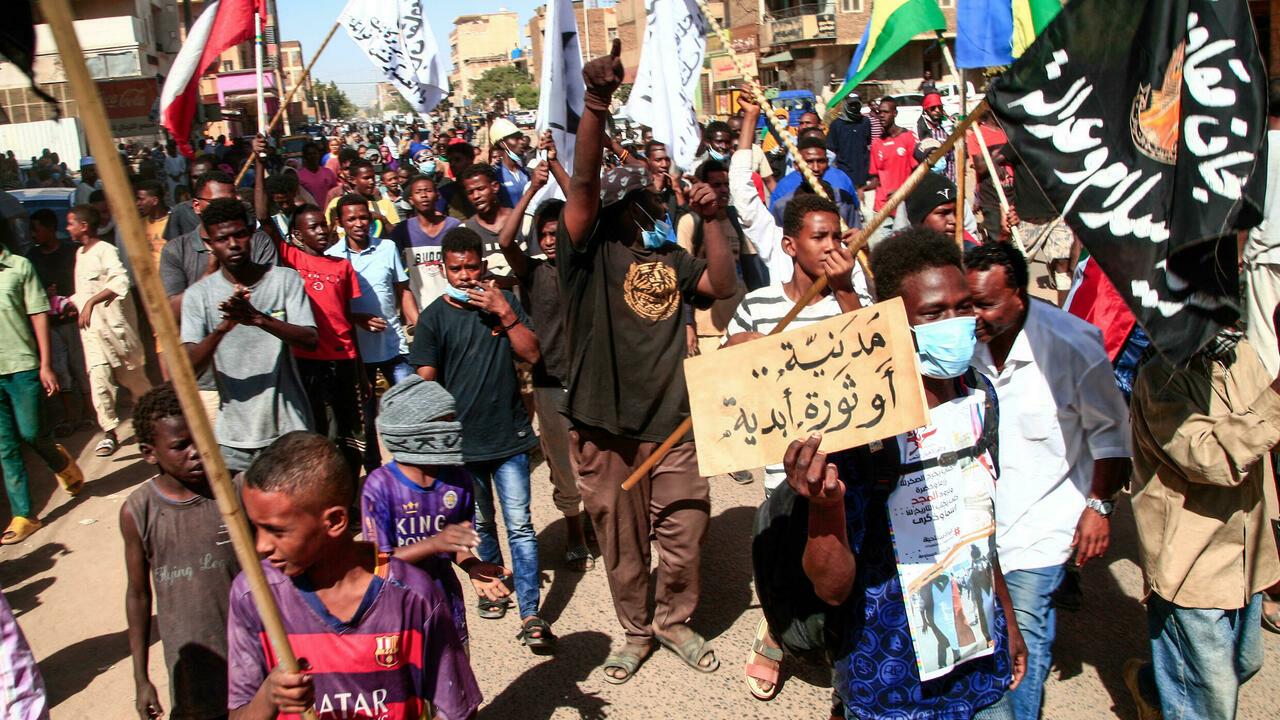
Early in the afternoon, the Popular Resistance Committees, spearheading the demonstrations, had not issued instructions and processions were forming in the capital. A few hundred meters from Khartoum's presidential palace, where the Sovereign Council is located, security forces fired tear gas grenades at demonstrators, AFP journalists observed.
This Thursday, the army deployed new resources to prevent the demonstration. Large cargo containers were placed overnight across the bridges leading to the center of Khartoum. It is impossible to pass. Only two smaller bridges, set apart, remain open to traffic, according to witnesses.
The roads leading to the district where the centers of power are located have also been blocked, report Sudanese journalists moving around the city. Cameras have been installed on the main streets and the avenue leading to the airport is cut off by barbed wire. Moreover, units of police, machine guns in hand, are regulating the traffic of vehicles venturing toward the heart of the capital.
As with every demonstration, internet access has been progressively cut off in the country. At 10 a.m. this Thursday, the monitoring group Netblocks observed a general outage across all operators.
In recent days, the most prominent members of the committees have been arrested, especially where they are best organized, in North Khartoum and Omdurman, on the other side of the Nile. But last night, popular protest appeared not to be weakening. Processions marched through the streets of these outlying neighborhoods, with megaphones, as a prelude to Thursday's demonstration.
Intelligence services have indeed had the right, "temporarily" since Monday, to monitor, arrest and detain civilians, which had no longer been the case since the fall of Omar al-Bashir's regime in 2019.
On the political and international front, the Sudanese issue is struggling to move forward. The president of the Sovereignty Council, General Abdelfatah al-Burhan, as well as Prime Minister Abdallah Hamdok, are still very much in demand.
The head of the UN mission in Sudan, the Saudi Foreign Minister, the Egyptian ambassador and the Secretary General of the Arab League have all indicated that they had spoken to one or the other. But all have remained at general terms and made no announcements.
According to the Sudanese press, they would be mainly trying to convince Abdallah Hamdok to abandon his intention to resign, which remains his apparent intention.
For its part, the Umma Party has drawn up a document for a way out of the crisis on which it still needs to build consensus with its partners in the Forces of Freedom and Change. The political situation is therefore still at a standstill.
Our editors' picks of what matters. Monday to Friday.
By subscribing, you accept our privacy policy.