Article
Preparing the article…
If a translation is needed, this may take a few seconds.
If a translation is needed, this may take a few seconds.
Abdouramane Sanoh, leader of the FNDC, the front that contested in the streets the third-term project for recently ousted Guinean president Alpha Condé, is handing over to another charismatic figure of the movement, Oumar Sylla alias Foniké Mangué. Ceremony held at FNDC headquarters...
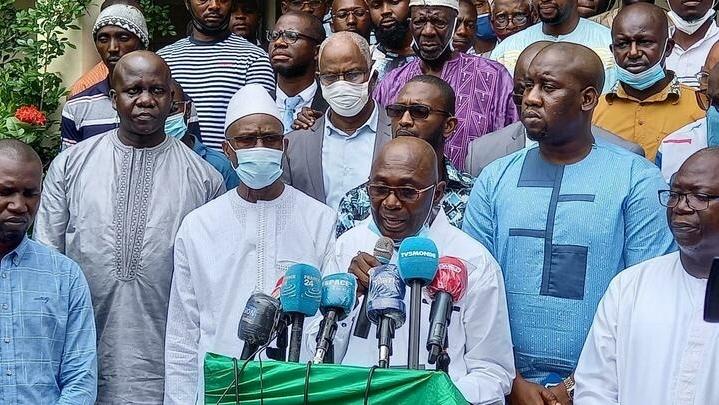
With our correspondent in Conakry, Moctar Bah
Civil society actors who mobilized as early as April 2019 to say no to Alpha Condé who wanted to amend the Constitution were all present or nearly so this Thursday for the plenary session in Conakry.
Since it is now nothing more than an unfortunate memory, the historic leader of the movement hands over to, in his own more vigorous terms: "On September 5, 2021, a new page of Guinea's political history opened. This new era is full of as many opportunities as challenges that they raise and which must be considered very calmly," explains Abdouramane Sanoh.
The new strongman of the movement is named Foniké Mangué. He was elected unanimously by internal vote. His personality achieved consensus: this young man, known for mobilizing crowds and who had been sentenced to three years in prison last year for "communication and dissemination of false information, particularly threats of violence or death," is a "transversal" figure from an "ethnic and political" point of view, explains an observer.
In December, Foniké Mangué was consulted by transition president Mamadi Doumbouya to lead the CNT (National Transition Council), the transition parliament. But another, more experienced civil society actor was ultimately appointed instead.
The FNDC is also changing direction: it wants to conduct oversight of the transition's course. With one tool: the House of Transition, which will monitor respect for human rights and will play the role of electoral watchdog, indicates an FNDC official. "The FNDC, sentinel of democracy, has committed to playing its full part in the success of the transition which is slow to actually begin in view of a rapid return to constitutional order," declared Foniké Mangué.
Through these gestures, the FNDC "materializes its autonomy vis-à-vis the military in power," explains researcher Kabinet Fofana. Main difficulty, for this group which has often been labeled close to Cellou Dalein Diallo's UFDG: "being objective and sincere," indicates Kabinet Fofana, "without giving the impression of being controlled by political parties."
Several dozen people, mostly young people, lost their lives in clashes between protesters against the third term and law enforcement between 2019 and 2020.
Our editors' picks of what matters. Monday to Friday.
By subscribing, you accept our privacy policy.