Article
Preparing the article…
If a translation is needed, this may take a few seconds.
If a translation is needed, this may take a few seconds.
The French ambassador to Mali has three days to leave the country. The decision was announced Monday, January 31 in early afternoon by the Malian transitional authorities, following a summons of Joël Meyer to the Ministry of Foreign Affairs. It is the ultimate episode of several months of tense exchanges between the authorities of the two countries and which casts enormous doubts on the future of relations between France and Mali.
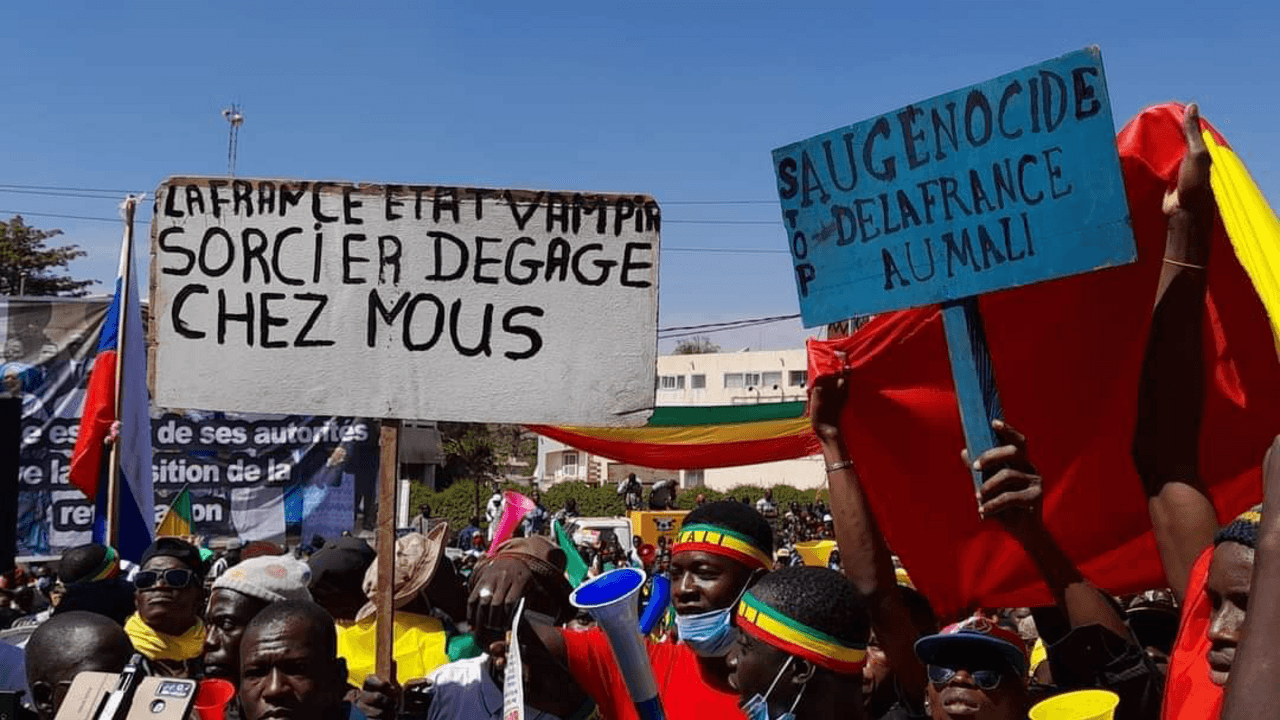
The expulsion of the French diplomat follows " hostile and outrageous statements " made in recent days by Jean-Yves le Drian. The French Foreign Minister had, among other things, described the transitional authorities as "illegitimate". The misunderstanding and animosity shared by the Malian and French authorities had never gone so far. But has the peak been reached?
Bamako wishes to " maintain dialogue and continue cooperation with all of its international partners, including France ". An invitation that is hardly reconcilable with the hard line that was chosen and which surprised many observers, including among those well versed in Malian politics. For its part, Paris "reiterates its commitment to the stabilization and development of the Sahel", but without specifically mentioning Mali.
► Read also : Mali: French ambassador ordered by authorities to leave the country within 72 hours
Since the expulsion of the Danish contingent from the Takuba force last week, the fifteen or so European countries that contribute to it have initiated a reflection on the future of this force, centered around Barkhane. Whose presence on Malian territory is increasingly contested in the streets. Bamako has also requested a series of amendments to current military agreements, Paris has not yet responded.
The Malian transitional authorities, who have also engaged in an arm wrestle with ECOWAS (Economic Community of West African States), appear determined to change their relations with their traditional partners, even at the risk of isolation. While reminding that other powers are available – Russia, but not only – and while wielding the banner of national sovereignty.
If exchanges have been difficult since the overthrow of Ibrahim Boubacar Keïta in August 2020, the tone truly escalated following the second military coup, in May 2021. On June 10, Emmanuel Macron announces a "profound transformation" of the French military presence in the Sahel. The following month, he specifies in particular the closure of the bases in Kidal, Tessalit and Timbuktu. A strategy that does not please transitional Prime Minister Choguel Maïga, who deplores an "abandonment in mid-flight", at the United Nations rostrum on September 25.
Response from the French president : " the Malian Prime Minister is the child of two coups d'état (…) the legitimacy of the current government is democratically null". It was in this context, at the end of December, that Emmanuel Macron cancelled his visit to Mali, officially due to the health crisis.
At the start of this year, it is the imposed withdrawal of the Danish contingent from the Takuba force that leads to acrimonious exchanges. French Minister of Armed Forces Florence Parly said a week ago that the junta was multiplying "provocations".
Colonel Abdoulaye Maïga, government spokesman, then gives as "advice" to Florence Parly to remain silent, accusing Paris of seeking to divide Malians, "instrumentalizing" sub-regional organizations and maintaining its "colonial reflexes". Then Foreign Minister Abdoulaye Diop, doubled down on RFI airwaves Friday, against remarks "tinged with contempt", warning that his country excluded "nothing" in its relations with France.
Furthermore, Paris has strongly opposed the possibility for Bamako to enter into new partnerships. In the crosshairs, the Russian private military company Wagner. So far, the Malian transitional authorities insist on one point: no contract has been signed with this private group. Despite their denials, the tone has continued to rise.
► Read also : Mali: has the deployment of Russian soldiers, or even Wagner, begun?
But relations between Paris and Bamako have also deteriorated over the question of the duration of the transition: at the end of October, the Malian authorities announced the postponement of elections scheduled for February 27 for security reasons, and since then, deep disagreements have come to light. Due to lack of consensus, ECOWAS imposed severe diplomatic and economic sanctions against Mali. Invoking the principle of national sovereignty, the Malian authorities accuse France of instrumentalizing sub-regional organizations.
Our editors' picks of what matters. Monday to Friday.
By subscribing, you accept our privacy policy.