Article
Preparing the article…
If a translation is needed, this may take a few seconds.
If a translation is needed, this may take a few seconds.
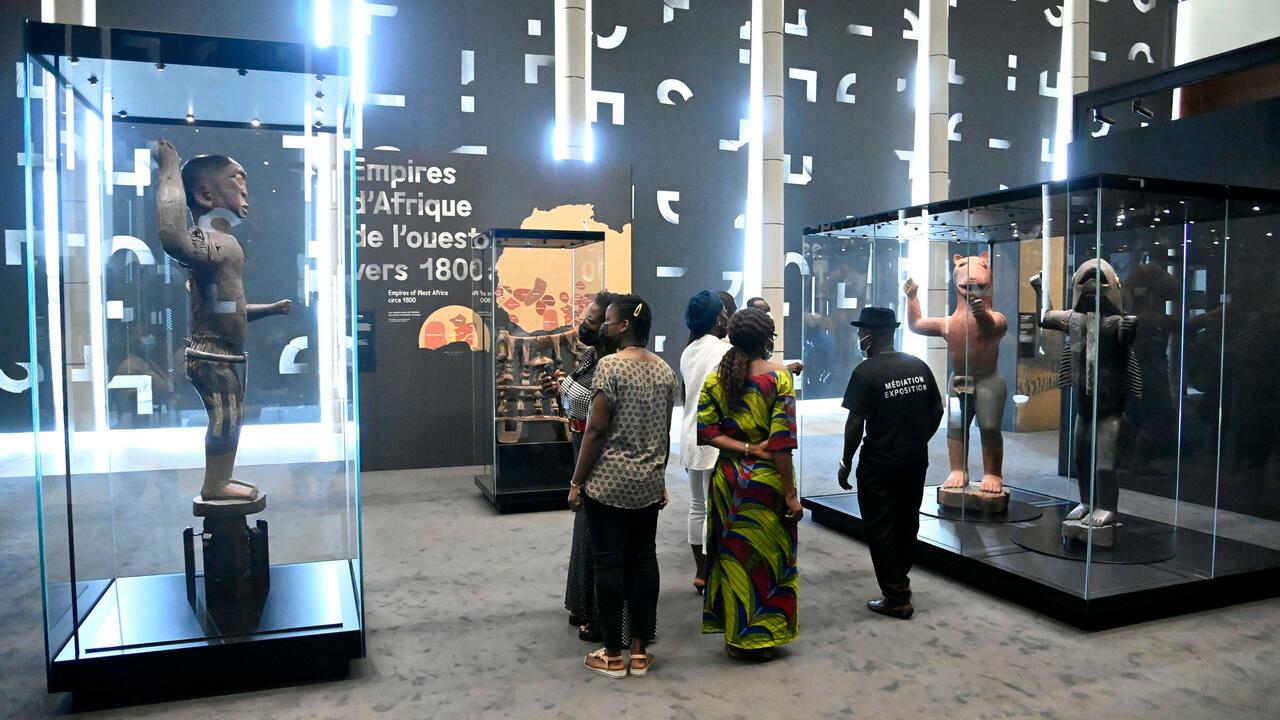
In Benin, visitors must queue to see the exhibition of 26 artworks from the kingdom of Abomey returned by France: more than 67,000 visitors have come since the opening on February 20. Thrones, statues, and an Amazon warrior's tunic are presented in a wing of the presidential palace in Cotonou, transformed into a museum and exceptionally opened to the public. This event is accompanied by a contemporary art exhibition, with around a hundred creations by Beninese artists.
With our correspondent in Cotonou, Delphine Bousquet
It is in Fon, one of the languages of Benin, that a guide presents the statue of King Guézo to market vendors from Cotonou gathered in front of the display case. Invited, there are around a hundred of them, to see with their own eyes these pieces that have been so talked about. Among them, Nan Guézo, from the royal family of Abomey: "Now, we are sure that the [artworks] have arrived. To tell the truth, it is joy for me. Everything that is here now is for the Beninese," she rejoices.
Visitors come from all over the country. Like these pupils from a private school in Porto Novo, whose parents contributed to pay for the bus. For Issa Elegbede, one of the teachers, the approach is essential: "in class," he explains, "we teach them this, but they don't have visual access to it. It is our duty to bring them here, so that they are in contact with History."
Beninese from the diaspora are even organizing their stay in the country around the exhibition. Christian Adjamonsi lives with his family in western France: "Everything was done on purpose for us to come visit. We cannot miss it, it is a unique opportunity," he asserts.
Because in addition to the 26 artworks, the contemporary art exhibition, designed as in the major galleries, also generates enthusiasm. Astrid Akoudawa, a young entrepreneur, photographs herself in front of the creations. "I did not expect to see such wonders," exclaims the young woman. "If I were elsewhere and someone told me it was in Benin, I would not have believed it. I will come back again."
Alain Godonou, a heritage specialist and head of the museum program at the National Agency for the Promotion of Heritage and Tourism, explains the reasons for this success: "the exhibition of Royal Treasures was anticipated," he analyzes. "There was a lot of political and media interest. When they were exhibited, we felt there was genuine expectation. It was like a popular deliverance and everyone wants to see it with their own eyes, almost touch it with their hands. There, people come in groups, or when they come as family, it is rather the extended family, the clan so to speak. All sorts of groups, diverse associations, business groups... We have received up to 200 or 300 people, which poses problems with flow management. There was truly a lack, a thirst, an expectation to come rediscover this heritage and perhaps something even more profound, which was to discover what we were."
The exhibition is scheduled to run until May 22, 2022.
►Also read: Restitution of African artworks: a report submitted to Emmanuel Macron
Our editors' picks of what matters. Monday to Friday.
By subscribing, you accept our privacy policy.