Article
Preparing the article…
If a translation is needed, this may take a few seconds.
If a translation is needed, this may take a few seconds.
In Kenya, a major flower producer, Valentine's Day is an economic boon. It triggers a peak in orders each year. But the consequences of the Covid-19 pandemic are still being felt. Between a shortage of aircraft and rising freight prices, exports are uncertain as the window for departure is tight, roses being a highly perishable commodity. Enough to worry the flower industry.
From our correspondent in Nairobi,
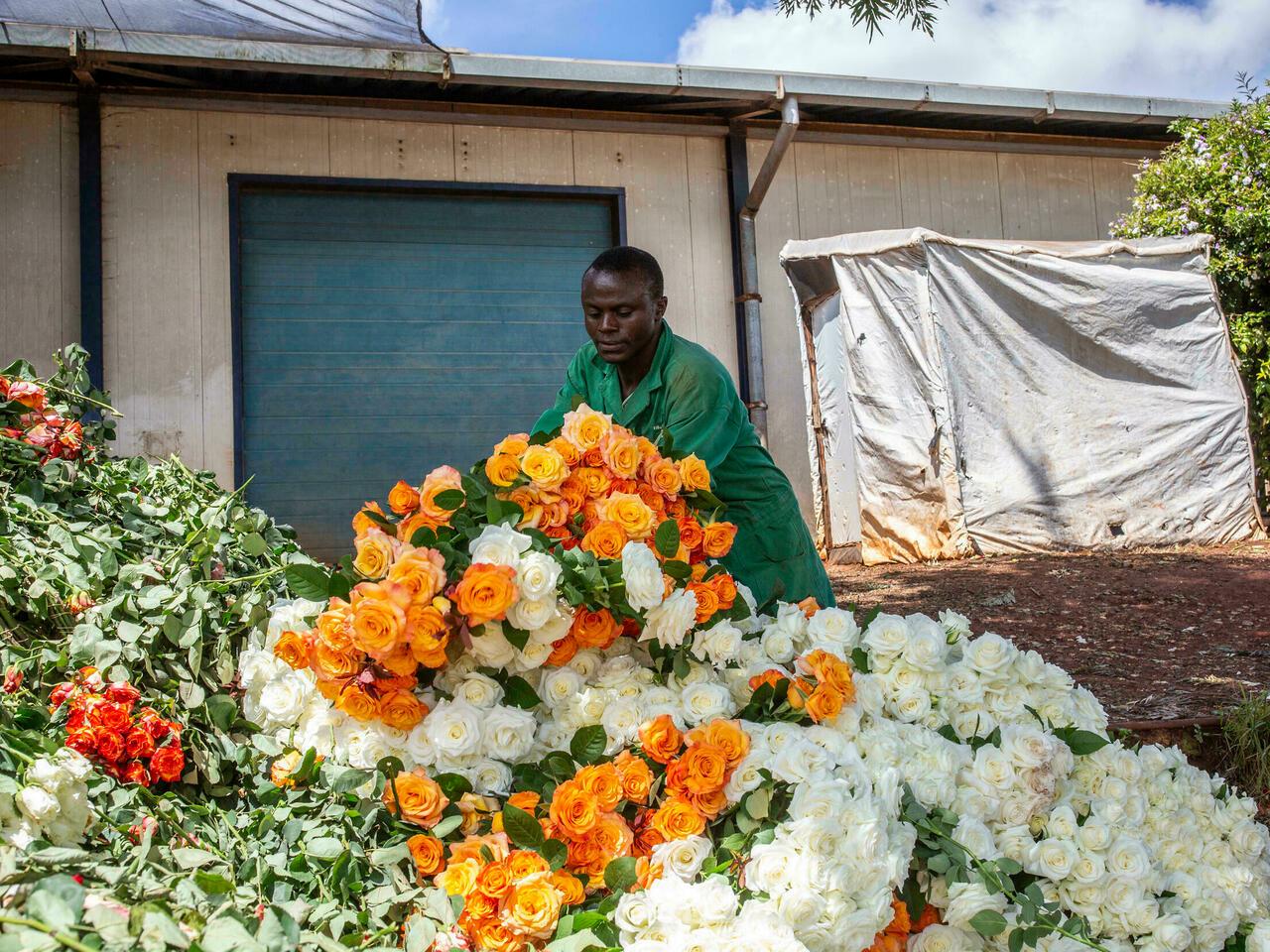
Red roses of course, but also white or orange ones. Under its greenhouses 35 kilometers from the Kenyan capital, Red Lands Roses grows nearly 200 varieties. Just days before Valentine's Day, its employees have no shortage of activities.
From planting to packing, everything is strictly orchestrated. "Our flowers are intended for export," explains Jared Obure, quality manager. "These are the ones we're going to put in boxes today. They stay in the meantime in this cold room, at a temperature between 1 and 2 degrees. From the harvest date, we have five days to send them. If there's no market and that storage date is exceeded, they are destroyed, because we can't sell a rose that's too old."
► Read also: Fair trade roses seek new growth for Valentine's Day
Once the bouquets are sold and packaged, the challenge is still to find space on an airplane. Which is not guaranteed at the moment, as flights departing from Kenya have not resumed their pre-Covid-19 pandemic frequency.
For Disha Copreaux, CEO of Red Lands Roses, "we never had problems finding space to export our flowers from Kenya to Europe before Covid-19. But just a few weeks ago, I was stressed because I wasn't sure I could send all our Valentine's Day orders, when it's a key season for us. Freight agents are not able to guarantee me in advance what percentage of my production they will be able to take on. It's really a day-to-day situation."
A situation that affects the entire sector, as explained by Clément Tulezi, general director of the Kenya Flower Council, which oversees the industry.
We still have obstacles in terms of freight. We have about 2,500 tonnes of flowers per week that we are unable to export. While at the moment demand is strong, we would need to send up to 5,300 tonnes on a weekly basis. It even happens that the truck goes to the airport only for the transport company to announce that there is finally no more space. So the flowers have to turn back and are mostly destroyed in the end. With this situation, export costs can triple compared to the pre-Covid period
Clément Tulezi remains optimistic nonetheless. Flower orders have moreover picked up again and he hopes for a return to normal by the end of the year. The economic stakes are high for Kenya, as the flower industry employs more than 200,000 people there and sustains no fewer than two million.
Our editors' picks of what matters. Monday to Friday.
By subscribing, you accept our privacy policy.